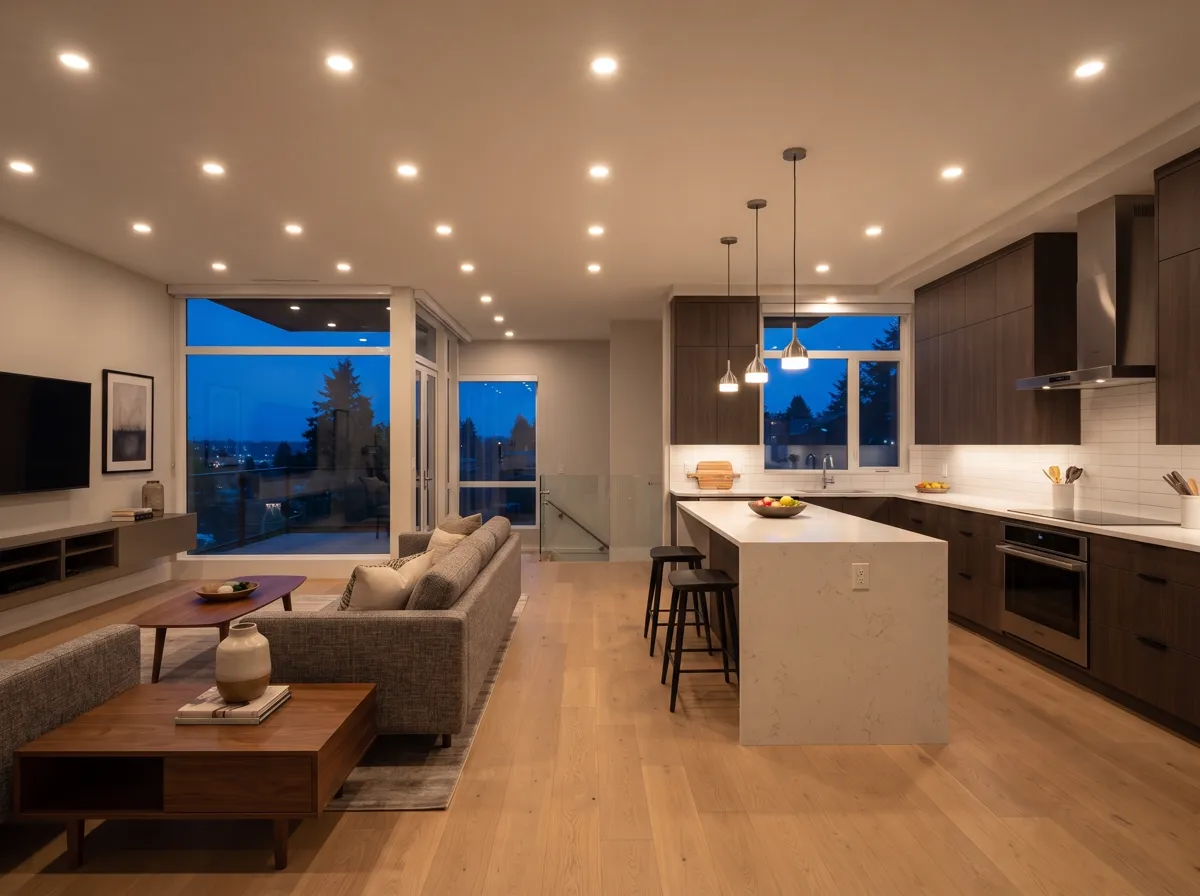
Why new lighting sometimes disappoints
Most of the regret is layout, not fixtures. Cans spaced evenly across a ceiling with no thought for what sits below them put light behind you at the counter and shadows on your hands at the sink. We mark the layout up on the ceiling first and walk it with you, because moving a circle of tape costs nothing and moving a hole does not.
Dimmers, drivers and color
LED fixtures and dimmers have to suit each other or you get buzz, flicker, or a light that will not go properly low. We tell you which combinations behave before they are in the ceiling. Color temperature is the other half of it: warm and neutral light in the same sightline reads as a mistake even when nobody can name why, so we pick one per room and stick to it.
What gets opened, and what gets put back
Most of the wiring can be fished through existing walls and ceilings using attics and crawlspaces. Where something has to be opened, we group the openings where they are easiest to patch and show you the spots before we cut, not after. Old fixtures also hide surprises — a crowded box, no ground, or a fan hung off a box never rated for one — and when that turns up we stop and show you.
How A Job Runs
- 01
We Look, And We Test
Not just at the thing you called about — at the panel, the load and how the house is fed. Most electrical problems are somewhere other than where you noticed them.
- 02
You Get A Fixed Price
In writing, before we start, including the permit. If the honest answer is that it can wait, we will say so and you can call us in a year.
- 03
Permit Pulled
We file it, and the work is scheduled around the inspection rather than hoping nobody asks. This is the part that matters when you sell.
- 04
Installed And Labelled
Conductors dressed, breakers labelled properly, and a panel schedule the next electrician can read.
- 05
Inspected And Signed Off
We meet the inspector, and you get the paperwork. A job with no record is a job you have to explain later.
Lighting & Fixtures: common questions
Can you add recessed lights without wrecking my ceiling?
Usually most of it, yes. The holes for the fixtures are the plan; the extra openings are for getting cable past a joist or a duct. We show you where those have to go before we start, and we patch what we open.
How many lights does a room need?
It depends on the ceiling height, the fixture and what you do in the room, so the honest answer comes from a layout rather than a formula. More is not better — too many cans at full output makes a room feel like a parking garage. We would rather add a dimmer than another hole.
Why do my LED lights buzz or flicker on the dimmer?
Almost always a mismatch between the dimmer and what is in the fixtures. Some combinations simply do not get along, and an old dimmer left behind after an LED swap is the usual culprit. It is normally a cheap fix once we know what is on the circuit.
Wiring homes throughout Washington County
Most of our work is in Washington County and the neighborhoods around it. Older housing stock is a large part of what we do, so if your house still has a fuse box or wiring nobody has looked at in forty years, that is a normal call and not an embarrassing one.